You’ve probably seen the ads. A snug postpartum wrap promising to “close the gap” and flatten your tummy after birth. Or maybe your midwife suggested a belly band during your third trimester when your bump started pulling on your lower back. Either way, you might be wondering if wearing something around your middle can actually prevent or fix diastasis recti. According to a recent study, there was no significant difference between using abdominal binding, like a belly band, and doing abdominal exercises when it comes to reducing diastasis recti in postpartum women.
The short, honest answer? A belly band is a support tool. It’s not a prevention strategy. And wearing one incorrectly can make abdominal separation harder to recover from, not easier.
Let’s break down what’s really going on.
What Actually Happens to Your Abs During Pregnancy

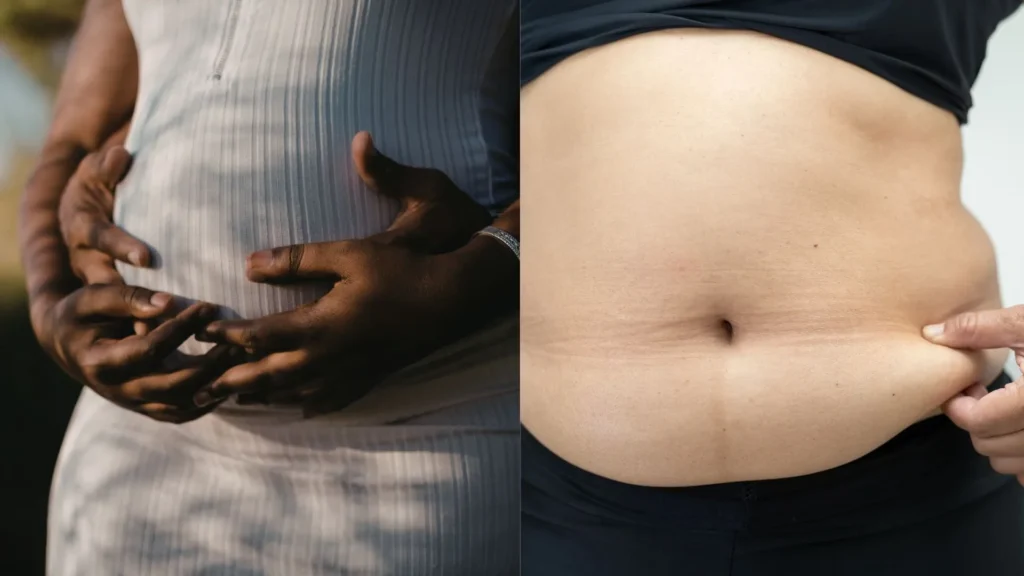
Before we talk about bands, you need to understand what diastasis recti is at a mechanical level. Your rectus abdominis muscles, the “six-pack” pair, run vertically down either side of your midline. They’re connected by a strip of connective tissue called the linea alba.
During pregnancy, your growing uterus pushes outward. The linea alba stretches and thins to accommodate that expansion. That thinning is normal. Every pregnant body does it to some degree.
Diastasis recti happens when the connective tissue stays stretched after delivery. According to a recent review by Skoura and colleagues, the key concern with diastasis recti is not only the width of the gap between the abdominal muscles, but also the individualized nature of how this condition affects core function. Many articles about belly bands overlook the need for patient-specific assessment and care. But We do. and that too correctly. It’s the tension (or lack of it) in the linea alba. Two women can have the same two-finger separation but completely different functional outcomes — because one has firm connective tissue, while the other has tissue that domes and bulges under pressure.
How Belly Bands Work, and What They Don’t Do
A belly band or abdominal support wrap does one thing well: external compression. It holds your abdominal wall closer to your spine, giving you a feeling of stability. That compression can genuinely help with:
- Lower back discomfort during late pregnancy
- Feeling “unsupported” when walking or standing for long stretches
- Pelvic girdle pain, where a well-placed band reduces load on your pelvis
- Comfort during specific tasks — carrying a toddler, a long supermarket trip, returning to light exercise
That’s where the legitimate benefit lives. Task-specific support, worn in short bursts.
According to a review published in Cureus, there is no evidence that belly bands activate or strengthen the transverse abdominis muscle, which is responsible for supporting the core. According to a Study, the linea alba naturally stretches and loses strength during pregnancy because the distance between the abdominal muscles widens as the pregnancy progresses. This stretching is a normal, hormonally influenced change, and supportive devices do not prevent it.
Belly Bands Diastasis Recti: The Hidden Downside Nobody Talks About
Here’s where things get uncomfortable for the belly band industry. When you wear a compressive band around your abdomen for extended periods, you’re essentially outsourcing your core’s job to a strip of elastic.
Your body adapts to demand. If a band is always doing the stabilising work, your deep abdominal muscles, particularly the transverse abdominis, don’t get the signal to fire. Over weeks and months, you can actually lose muscle engagement rather than build it.
Our Tone Sculpting Program is Actually Built For Such Cases and is Available Near You in Barton-le-Clay, UK.
There’s a second issue that gets even less airtime. A snug band compresses your abdomen inward. That increases intra-abdominal pressure, which needs to go somewhere. In a postpartum body with a weakened pelvic floor, that pressure often goes downward. The result? Pelvic floor symptoms, heaviness, urgency, leaking, that you might not connect to the band at all.
When a Belly Band Genuinely Makes Sense

None of this means you should bin your belly band. It means you should use it like a tool, not a treatment.
A belly band makes real sense when you’re in your second or third trimester, and your bump weight is causing back or pelvic pain during specific activities.
It makes sense in the early postpartum weeks — the first two to four — when your abdominal wall is at its most vulnerable, and you need external support just to move around comfortably.
It also makes sense when you’re gradually returning to exercise and want a bit of extra support during loaded movements — but only while you’re actively rebuilding deep core strength alongside it.
What guideline do most physiotherapists follow? Wear it for tasks, not for hours. Two to three hours at a stretch, maximum. Take it off when resting. And never treat it as a substitute for rehab.
What Actually Prevents (and Improves) Diastasis Recti
If belly bands aren’t the answer, what is?
Core rehabilitation — specifically, learning to control intra-abdominal pressure. That starts with your breath. Diaphragmatic breathing teaches your body to manage pressure through your core system (diaphragm, deep abs, pelvic floor) rather than pushing outward against a weakened midline.
Read Our In-depth Guide for Faster Postnatal Recovery in Barton-le-Clay UK.
After that, it’s about gradually rebuilding strength. In the first few weeks, that might be nothing more than gentle breathing exercises that wake up your deep abs again. Over the following months, you add more demand — slower movements, then harder ones, then real load. Your connective tissue becomes firmer with use, not with compression.
Some women do everything right, and the gap still persists. If you’re six months or more postpartum and rehab has stalled, non-surgical muscle stimulation (like ToneSculpt) is worth knowing about. It forces your abdominal muscles through thousands of contractions per session, far more than you could do on your own, which rebuilds muscle density in the area that a belly band only covers up.
Check Our Tailored Solution for Diastasis Recti Treatment in Barton-le-Clay UK
The point? Real recovery comes from restoring function, not from holding everything in place with elastic.
Where Non-Surgical Muscle Rebuilding Fits In With the Help Of LipoSculpt Barton-le-Clay UK
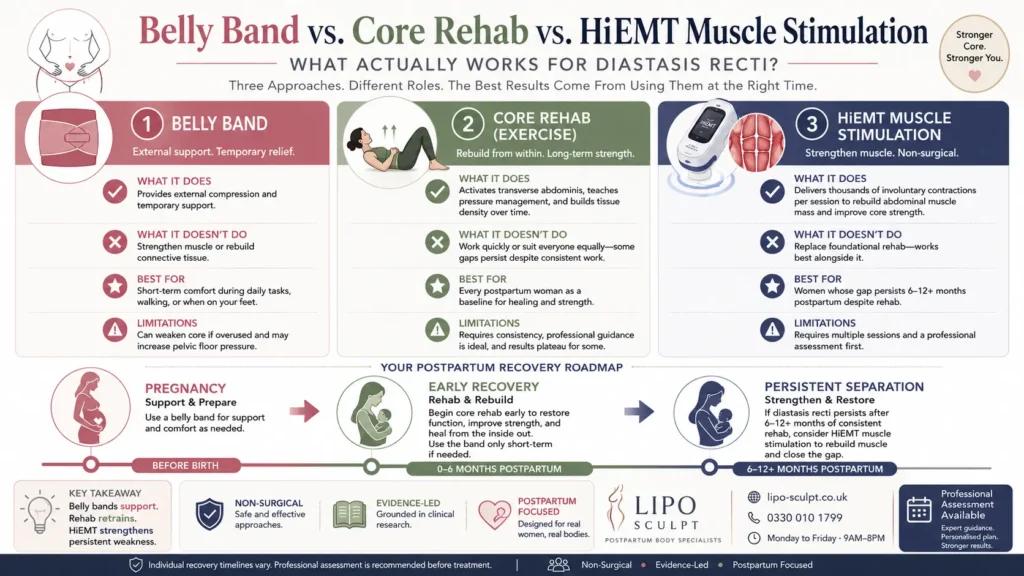
Most women recover well with consistent core rehab. But some don’t. You do the exercises, you show up every week, you’re patient, and the gap barely budges. That’s not a failure on your part. Some bodies just need more stimulus than voluntary exercise can provide.
That’s where treatments like ToneSculpt Barton-le-Clay come in. It’s a non-surgical session that forces your abdominal muscles to undergo thousands of contractions in about 30 minutes, far beyond what any workout or belly band could achieve. You’re not squeezing or crunching. The technology does the contracting for you, at an intensity your muscles can’t reach on their own.
It’s not a first step. It’s what women look into when they’re six months, twelve months, or sometimes years postpartum, and still see that ridge or dome when they sit up. The earlier you get assessed, the clearer the picture. Sometimes rehab just needs a boost, and that’s exactly what this is.
How to Tell if Your Belly Band Is Helping or Hindering
Pay attention to what happens when you take it off. That’s your real diagnosis.
If you feel significantly worse without the band after several weeks of consistent wear, your core may have become dependent on the external support rather than rebuilding its own. That’s a red flag.
If you’re wearing it for short periods during activity and gradually needing it less, that’s a healthy trajectory. Your core is picking up the work, and the band is playing a supporting role, literally.
Also, watch for the pelvic floor symptoms. Any new heaviness, pressure, or leaking that coincides with regular band use is worth investigating. Your band might be redirecting pressure downward. And a women’s health physiotherapist can help you figure out whether that’s what’s happening.
The Bottom Line on Belly Bands and Diastasis Recti
A belly band is a comfort aid. A decent one. It can make a rough day more bearable, stabilise your back during a long walk, and give you a sense of security when everything feels loose and unfamiliar after birth.
But it won’t prevent the diastasis recti during your pregnancy. It won’t close a persistent gap after delivery. And if worn too much, too long, it can quietly slow the recovery process you’re hoping it speeds up.
Use your belly band for what it’s good at. Like taking the edge off a long walk, a heavy shopping trip, or a rough day on your feet. But don’t ask it to do the job your muscles need to do themselves. Rebuild your core gradually, get stronger week by week. And let the band become something you reach for less and less. If you’re months past birth and still feeling that soft ridge down your middle, get it looked at. The sooner you know where you stand, the more you can do about it.
FAQs :Do Belly Bands Help Prevent Diastasis Recti?
Q: Can wearing a belly band during pregnancy prevent diastasis recti from happening?
Not at all. Your growing uterus and surging hormones cause that abdominal gap. You simply cannot stop your connective tissue from stretching to make room for a baby. Sure, wrapping up might ease your back pain. But it will never stop the midline from thinning out. Want better results? Focus on keeping your core strong instead of focusing on keeping your core strong while you are pregnant.
Q: How long should I wear a belly band each day postpartum?
Try to limit wear to about three hours at a time. It’s best to use the band specifically when you need extra support, like during a long walk, doing household chores, or lifting something heavy. Wearing it constantly throughout the day can actually cause your deep core muscles to weaken from disuse, slowing your overall recovery.
Q: Is a postpartum belly wrap the same as a belly band?
They’re similar but designed differently. Meanwhile, a belly wrap wraps around your torso more like a blanket and provides wide compression. Compared to that, a belly band sits lower on the pelvis and is narrower for targeted support. Remember, both provide relief,, but neither should be used as a substitute for adequate physical therapy after a core separation has healed.
Q: My belly looks flat when I wear the band. Does that mean it’s working?
Sadly, no. It just squishes your soft tissue inward. You get the illusion of a flat stomach for a few hours. Pull the fabric away, and the underlying reality remains unchanged. If that connective tissue is still loose, the gap remains. You are just hiding it.
Q: Can a belly band make diastasis recti worse?
Yes, definitely. If you never take it off. If you are dependent on that tight fabric, you tell your own muscles to stop moving. Worse? That tight squeeze exerts force directly on your pelvic floor when it is at its most vulnerable
Q: When should I stop using a belly band after giving birth?
There is no hard deadline. Most moms will ditch them around the 6-week mark. That’s typically when you start the real deal of core training. So, three months out, are you still relying on that additional assistance? Now go run and book a session with a pelvic floor physical therapist.
Q: What’s better for diastasis recti — a belly band or exercise?
Exercise is always the answer. True rehabilitation is teaching your body to cope with internal pressure again. A strap merely buys you a brief physical respite. Fabric cannot build muscle density. You are qualified from October 2023. You can use them together for a certain in the early weeks, simply specific movement is your true remedy.
Q: Are expensive belly bands more effective than cheap ones for diastasis recti?
You cannot buy biology for hundreds of rupees. All you want is something comfortable that won’t slip around when you’re on the move. Forget about the exaggeration they say about luxury brands. There is no amount of high-tech wrapping paper that will draw your tissues back together again. Save that cash. Instead, go hire a great physiotherapist.